Withdraw
Withdraw by unstaking sPLUSD to PLUSD if needed, escrowing PLUSD into the WithdrawalQueue, and claiming USDC yourself. The claim re-screens your address, burns your PLUSD, and pulls USDC from the Withdrawal Queue Wallet via the queue contract’s standing allowance. Single call, no off-chain signer in the critical path.
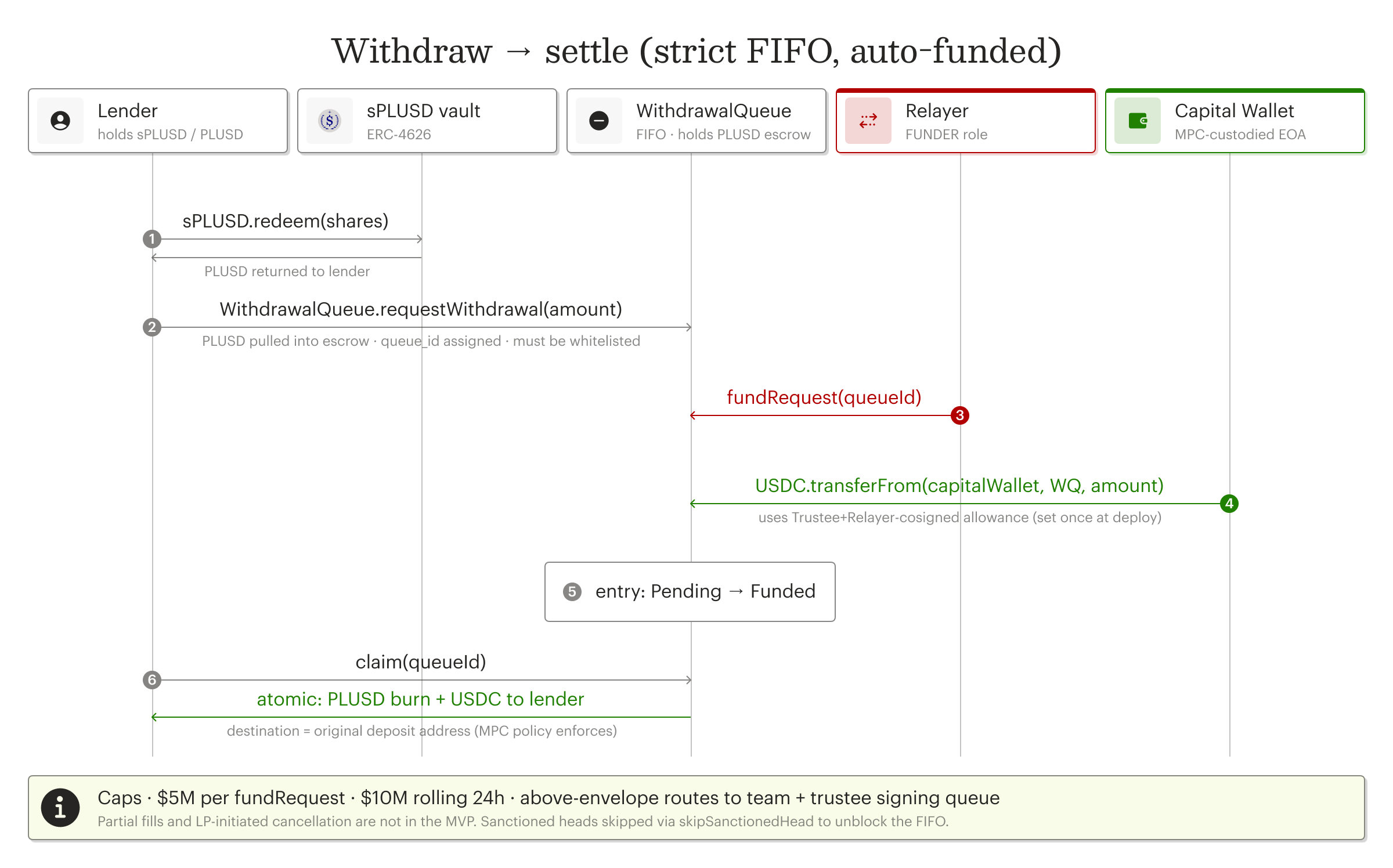
Flow
- Unstake sPLUSD by calling
sPLUSD.redeem(shares). PLUSD returns to your wallet. Skip if you already hold PLUSD. - Call
WithdrawalQueue.requestWithdrawal(amount). Your PLUSD moves into the queue's escrow and aqueue_idis assigned. The queue'stotalRequestedaggregate increases. The PLUSD transfer to the queue triggersPLUSD._update, which checks your whitelist entry and the 90-day freshness window. A stale or revoked entry reverts the request. - The Relayer detects your request and runs KYT on your address off-chain. On a clean result, the Relayer signs a claim attestation and serves it via API. Your frontend fetches the attestation when ready.
- Call
WithdrawalQueue.claim(queueId, attestation, signature)yourself when you're ready. The queue verifies the signature against the configured attestor address, re-checksWhitelistRegistry.isAllowed(you)as a backstop, checksclaimAmount ≤ totalClaimable, callsUSDC.transferFrom(WithdrawalQueueWallet, you, amount)against the standing allowance, burns your escrowed PLUSD, and incrementstotalClaimed. All in the same transaction.
Compliance re-check at claim
Whitelist entries can be revoked between request and claim if a sanctions hit lands on your address (passive re-screening, OFAC list update, manual revoke). The claim re-check catches this. If revoked, the claim reverts and your escrowed PLUSD stays in the queue pending ADMIN disposition.
If your whitelist entry’s freshness window expires (no clean screen in 90 days), the request itself reverts at PLUSD._update. Re-enrol via the standalone enrolment endpoint (see Onboarding) to refresh, then retry the request.
Queue aggregates
The WithdrawalQueue tracks three numbers that bound everything:
| Aggregate | What it is |
|---|---|
totalRequested |
Cumulative PLUSD escrowed across all withdrawal requests ever submitted |
totalClaimed |
Cumulative USDC paid out (equals cumulative PLUSD burned via claim) |
totalClaimable |
Currently outstanding obligations: totalRequested - totalClaimed |
The safety invariant on every claim is require(claimAmount ≤ totalClaimable). This is independent of the allowance from the Withdrawal Queue Wallet. Even if allowance is set to MAX_UINT, the queue physically refuses to pull more than it owes. Allowance is the permission ceiling. The aggregate ledger is the spending discipline.
Delays
- Withdrawal Queue Wallet underfunded. If the Wallet’s USDC balance falls below the queue’s outstanding obligations, claims revert until the next Trustee and Team top-up. Top-ups are routine. The Trustee monitors the wallet’s balance against the queue’s
totalClaimableand triggers a top-up before it bites. - Capital Wallet itself is short (for example, 15% USDC buffer depleted). The Trustee instructs a USYC sale against the Hashnote redemption rail before topping up the Withdrawal Queue Wallet. Typically about a day, longer for large amounts.
- Your compliance screen expired between request and claim. Unlikely unless you stop using the app for 90 days mid-queue. Re-enrol to refresh.
- Sanctions hit on your address between request and claim. The claim reverts. Contact compliance.
- GUARDIAN paused the WithdrawalQueue contract. Check the status page before retrying.
During shutdown
If the protocol has set an exchange coefficient on the WithdrawalQueue (see Default management), every claim pays out USDC at face_value * coefficient instead of face_value * 1.0. The coefficient applies the same way to PLUSD direct-redeem and sPLUSD-unstake-then-redeem. The coefficient ratchets up only as recoveries land. Once coefficient = 1.0, normal economics resume.
There is no separate “shutdown mode”. The protocol continues operating with the haircut applied at the queue.