Capital layer
The Capital Layer is where Pipeline holds and moves real money. Trade finance is a fiat business — sellers, offtakers, and banks wire in USD. Pipeline needs a layer that can hold dollars, disburse loan proceeds, and receive offtaker wires.
Architecture
The Capital Layer answers four operational requirements:
- Hold lender USDC under institutional custody.
- Bridge USDC and USD via a dedicated bank account.
- Maintain a yield-bearing reserve — non-deployed capital sits in tokenised T-bills, accruing yield.
- Isolate new deposits under ongoing KYT checks and withdrawal cash from the rest.
For these purposes, Pipeline sets up the infrastructure of four wallets in the institutional custody (BitGo) and a USD bank account, all under fiduciary control.
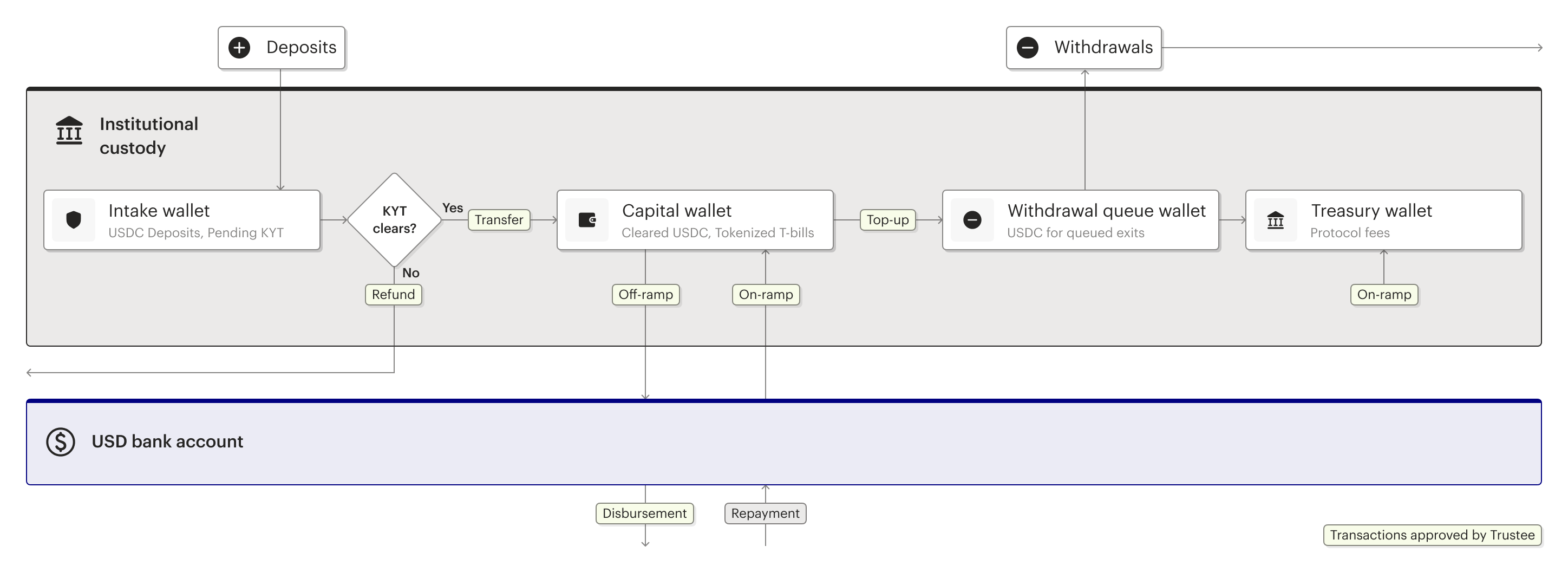
No protocol contract can spend from this layer. Every movement requires the 3-of-5 cosigner quorum.
Institutional custody
All on-chain capital is held with BitGo under multi-party computation custody. Four wallets sit under a single 5-share, 3-of-5 cosigner policy: the Trustee, two Pipeline Team shares, and two independent External Counterparties. No single party can move funds. A hard policy rule requires the Trustee to participate in every signing quorum.
Intake Wallet
Every lender USDC deposit arrives here first and remains until KYT screening clears. Holding incoming funds in a separate wallet simplifies accounting — only cleared capital reaches the Capital Wallet, and PLUSD totalSupply matches cleared capital exactly. If a deposit fails KYT, the Trustee returns it to the source wallet under standard cosigner quorum.
Capital Wallet
Holds lender USDC plus the USYC reserve. Funds enter from the Intake Wallet on KYT clearance, from offtaker repayments via the USD bank account, and from tokenised T-bills (USYC) redemptions. Funds exit to fund loans, replenish the Withdrawal Queue Wallet, and purchase USYC.
A target USDC buffer of 15% (band 10–20%) sits in the wallet against routine outflows. The remainder sits as USYC, accruing T-bill yield daily. NAV is unrealised until the Trustee instructs the wallet to sell USYC for USDC against the Hashnote redemption rail. Realised proceeds feed a PLUSD yield mint.
Withdrawal Queue Wallet
A separate institutional-custody address that holds USDC earmarked for lender withdrawals. The Trustee and Team periodically top it up from the Capital Wallet under the 3-of-5 cosigner quorum. The on-chain WithdrawalQueue contract pulls from this wallet (not from the Capital Wallet) when a lender claims, against an allowance the Queue Wallet has granted to the contract. Isolating settlement funds in their own wallet means a WithdrawalQueue contract bug or exploit can drain only the topped-up amount, not the full Capital Wallet.
Treasury Wallet
Collects protocol fees — management, performance, and the OET allocation. Funds operating expenses and the Operational Expense Trust runway reserve.
USD bank account
Held in the Trustee’s name. The account receives offtaker wires when cargo is paid for, and originates outgoing instructions to fund loans and on-ramp dollar inflows. Conversion between USD and USDC runs through the Payment Agent (Circle Mint).
The account is subject to the same fiduciary discipline as the on-chain wallets — every disbursement is initiated by the Trustee against documented protocol instructions, and every inflow is reconciled to a specific loan repayment or capital movement.
Emergency disconnect
Custody policy carries a hardware circuit breaker that disconnects the Capital Wallet and the Withdrawal Queue Wallet from the protocol contracts on alarm. Pre-approved allowances are revoked, all standing transfer authorisations are frozen. The breaker is a custody-side action. It does not require a smart-contract upgrade or a governance vote, and BitGo cannot pull this lever.
How the Trustee manages capital
Every movement out of any custody wallet requires the 3-of-5 cosigner quorum. Initiated by Pipeline Operations, signed under the BitGo policy by the relevant cosigners (Trustee mandatory).
The Trustee’s day-to-day operations include:
- KYT-cleared releases — moving cleared deposits from the Intake Wallet to the Capital Wallet.
- Loan funding — drawing senior tranche capital from the Capital Wallet against an approved loan and routing it via the Payment Agent to the seller account.
- Withdrawal Queue replenishment — topping up the Withdrawal Queue Wallet from the Capital Wallet against the queue’s outstanding obligations.
- T-bills management — acquiring tokenised T-bills from unallocated USDC above the buffer, and selling them for USDC when buffer replenishment requires it.
- Treasury sweeps — allocating yield-mint fees to the Treasury Wallet under the published fee schedule.
- Repayment on-ramping — receiving offtaker wires into the USD bank account and instructing USD/USDC conversion via the Payment Agent.
- KYT-failure returns — returning Intake Wallet funds to the source wallet when a deposit fails screening.
Standing transfer authorisations exist only for the WithdrawalQueue contract pulling against the Withdrawal Queue Wallet, bounded by the queue’s totalClaimable ledger ceiling.