Where yield comes from
Pipeline pays yield from two real, ongoing flows — repayments on commodity trade loans and Treasury-bill accrual on idle reserves — and the sPLUSD share token captures both.
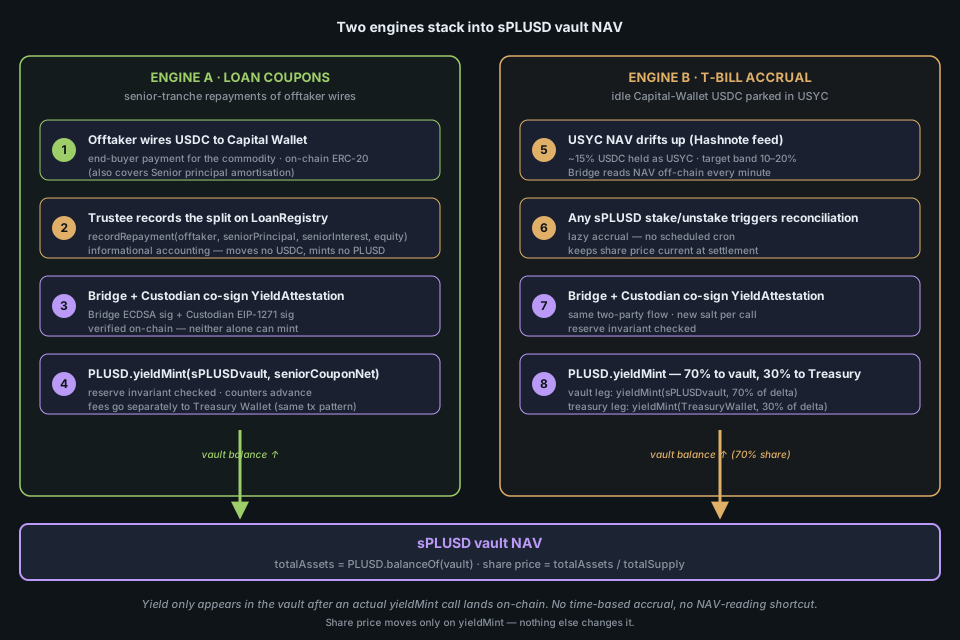
- Offtaker wires USDC to the Capital Wallet when the cargo is sold.
- Trustee records the repayment split on LoanRegistry (informational only — no tokens move).
- Bridge and Custodian co-sign a
YieldAttestationafter verifying the USDC inflow. PLUSD.yieldMintdelivers the senior coupon leg to the sPLUSD vault.- USYC NAV drifts up continuously as T-bills accrue at the custodian.
- A stake or unstake on sPLUSD triggers the lazy NAV reconciliation.
- Bridge and Custodian co-sign a fresh
YieldAttestationwith a new salt. PLUSD.yieldMintsplits the NAV delta — 70% to the sPLUSD vault, 30% to the Treasury Wallet.
Engine A — Senior-tranche coupons on trade loans
Every Pipeline loan is cut into two tranches. The senior tranche is funded by Pipeline lenders through the vault. The equity tranche is funded by the loan originator and absorbs first losses. When the offtaker — the end buyer of the commodity — pays for the cargo, that USDC arrives at the Capital Wallet. The trustee splits it into senior principal, senior interest (net of fees), and an equity residual returned to the originator.
Fees come out before the senior coupon reaches the vault:
- Management fee — 0.5–1.5% per annum on deployed senior principal.
- Performance fee — 10–20% of senior net interest.
- OET allocation — 0.05–0.10% per annum, funding the on-chain operations endowment.
All three route to the Treasury Wallet, not to the vault. The senior coupon net — gross senior interest minus management fee minus performance fee — is the amount lenders actually receive.
The moment yield lands in the vault is the yield-mint event. Bridge and the
custodian co-sign a YieldAttestation, and PLUSD.yieldMint delivers new
PLUSD to the sPLUSD vault. That new PLUSD is what moves the share price
upward. Neither Bridge nor the custodian can mint alone; both signatures are
verified on-chain.
Engine B — T-bill accrual on USYC reserves
The Capital Wallet holds roughly 15% of reserves in USDC so lenders can withdraw instantly — the band runs 10–20% and is rebalanced by the custodian and trustee. The rest sits in USYC, Hashnote’s tokenized Treasury-bill vehicle. USYC’s NAV drifts up as the underlying bills accrue, and the Capital Wallet’s USYC balance earns that drift directly.
Distribution on each reconciliation:
- 70% of the NAV delta is minted to the sPLUSD vault.
- 30% is minted to the Treasury Wallet.
The same two-party attestation applies: Bridge signs, the custodian co-signs, and PLUSD checks both on-chain before minting.
T-bill yield is minted lazily — when someone stakes or unstakes sPLUSD, not on a clock. Between mints, the accrued-but-undistributed amount shows on the dashboard. If nobody interacts with the vault for a while, the accrual still lands the next time anyone does.
Where yield does NOT come from
- No perpetual-futures funding rates. Pipeline does not run a basis trade.
- No leverage on the deposit side. You are not borrowing against your sPLUSD position to amplify returns.
- No rehypothecation of the USDC reserve. The reserve does not get lent into third-party DeFi venues.
- No token emissions. There is no governance token dripping value. sPLUSD share price is the return.
Where the money sits between repayments
Idle USDC and USYC sit at the custodian — both are on-chain ERC-20 holdings at the Capital Wallet address, controlled by MPC cosigners. USYC earns the T-bill yield every day, whether or not a loan repaid that week. See custody and split-rail architecture for how the cash rail is structured.
Share price mechanics
sPLUSD share price moves only when a new yield mint lands in the vault — not
on a clock, and not when the trustee writes a repayment entry to the
LoanRegistry. The yield mint is the event. LoanRegistry writes are
informational; they confirm that a repayment happened, but they do not change
share price. Only PLUSD.yieldMint, gated by the two-party attestation and
the on-chain reserve invariant, moves NAV.
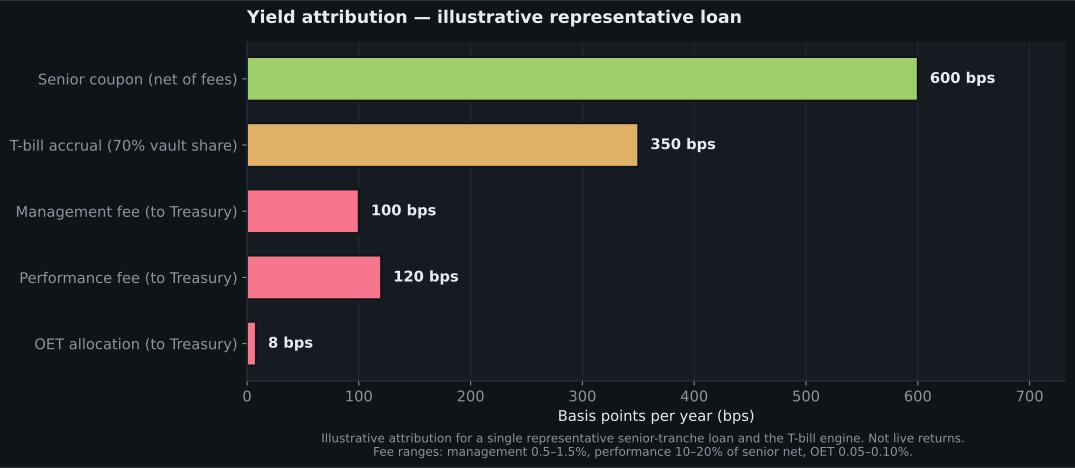
Both engines stack into the same share price. A quarter with heavy repayments shows most of the lift from Engine A. A quiet quarter with few repayments shows Engine B carrying more of the accrual. Over a full year, both contribute — and both arrive through the same co-signed mint path, against the same 1:1 backing invariant PLUSD enforces on every call.